Tuesday, November 22, 2011

A Trip to Muir Woods and the Effect of Phytophthora ramorum (Sudden Oak Death)

Thanks to the National Plant Diagnostic Network (NPDN) meeting, I was able to make my first trip to California.  In addition to some awesome, diagnostic workshops and meetings, we were able to choose one of four field trips/tours.  It was a very, hard decision, but I chose: Phytophthora ramorum-Redwoods Tour-
Marin County.

Basically, on the this tour, we were taken to the site where Sudden Oak Death (P. ramorum) was first discovered in the United States.
"Since the early 1990s, oaks and tanoaks have been dying in the coastal counties of California. Since then, other types of plants have been found to be infected or associated with this disease, referred to as Sudden Oak Death (SOD), ramorum leaf blight or ramorum dieback. Phytophthora ramorum is the pathogen that causes these diseases. Sudden Oak Death was first reported in 1995 in Mill Valley (Marin County) on tanoak. Since that time, the pathogen has been confirmed on various native hosts in fourteen coastal California counties (Marin, Santa Cruz, Sonoma, Napa, San Mateo, Monterey, Santa Clara, Mendocino, Solano, Alameda, Contra Costa, Humboldt, Lake, and San Francisco), and in Curry County, Oregon. Through ongoing surveys, APHIS-PPQ continues to define the extent of the pathogen’s distribution in the US and limit its artificial spread beyond infected areas through quarantine and a public education program." -USDA-APHIS
Case Study: Sudden Oak Death /ramorum blight caused by Phytophthora ramorum

This tour included a visit to Muir Woods!

There is an abundance of information and stories that could come from Muir Woods, but the one I would like to share is that of the trees located there.  The large live trees located at Muir Woods mostly consist of coastal redwoods; however, there are some scattered Douglas Firs there.  The tallest coastal redwood stands 258 feet tall ("A six foot person stacked 45 times").  The average coastal redwood is 600 to 800 years old and the oldest is 1200 years old. -Now, that is old!  In the understory of these magnificent trees are tanoaks.

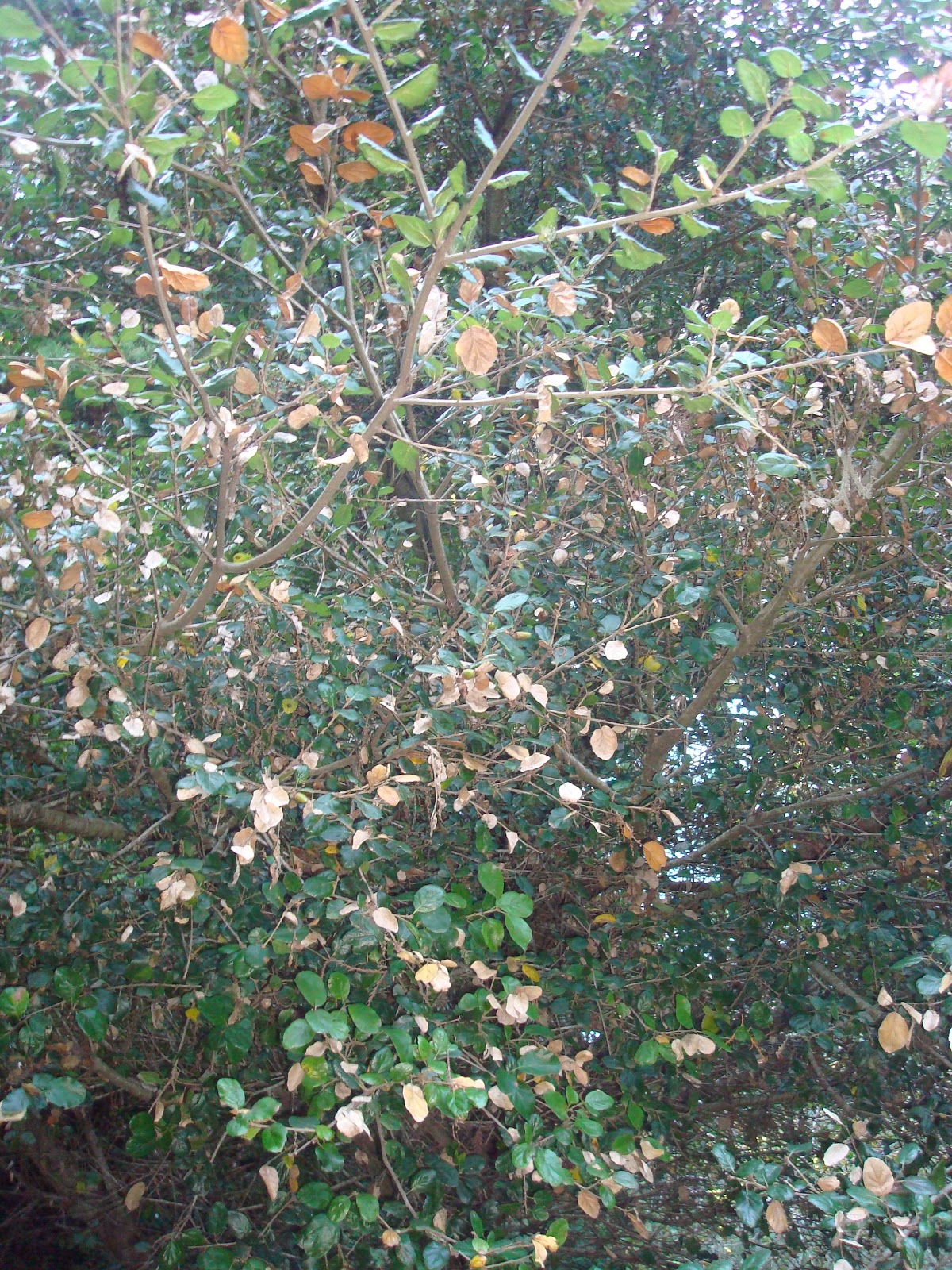
Unfortunately, many of the tanoaks in Muir Woods are infected with Phytophthora ramorum or SOD (Sudden Oak Death). Most of the trees are dying. To a plant pathologist the story may end here.  We took many pictures, so that we would have record of the symptoms of tragedy, in the hope that we can catch it before it enters our State, like Illinois.  What I did not realize, is how much this disease is affecting the ecosystem of Muir woods.


Note the dark, cankers on the tanoaks, which are symptoms of Sudden Oak Death caused the the fungal pathogen, Phytophthora ramorum.   For more information, go to:  http://www.suddenoakdeath.org/

If the tanoaks die-then there are no acorns...
If there are no acorns, then there will be no food for the forest rats.....
If the forest rats have no food, then they could possibly die, and then the endangered spotted owls will have no food....

And so, there are many ecological studies taking place to study the many ecosystems, like this one at Muir Woods.


In most of the pictures, the browning foliage belongs to dying tanoaks in Muir Woods.


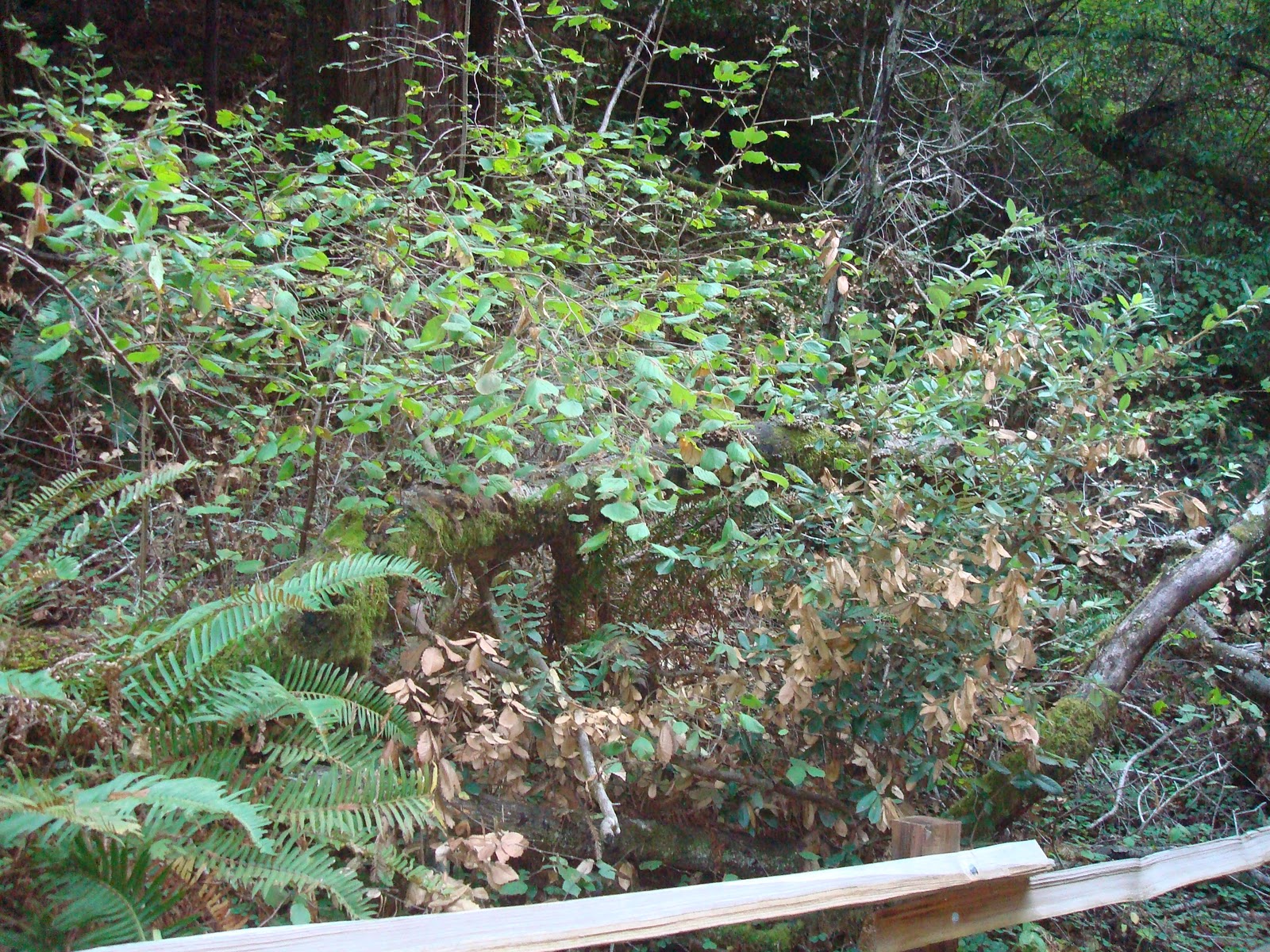


I wish I could end my story here, but the horror of it is, this fungal disease pathogen,  P. ramorum, not only affects oaks, but also has been found to infect over 200 plant hosts and counting....
http://www.aphis.usda.gov/plant_health/plant_pest_info/pram/downloads/pdf_files/usdaprlist.pdf 

Here is how you can prevent the spread of this pathogen to your "neck of the woods": http://www.aphis.usda.gov/publications/plant_health/content/printable_version/SBR_StopTheSpread.pdf

Friday, November 18, 2011

Greenhouse Poinsettias with Pythium root rot

When these plants were examined, the roots appeared to be rotted.  When the root tissue was examined under the microscope, there were oospores present.  This is a sign of Pythium root rot.  The visual symptoms of the poinsettia roots also appeared to be those associated with Pythium root rot at various stages of infection.

Pythium can be introduced to plants by infested crop debris in the greenhouse, transplanting infected cuttings, or recycling potting mix or containers.  In addition, in some cases, this pathogen can be introduced by contaminated irrigation water.  The problem could also be that the potting medium is not draining properly.  Remember, environmental conditions can cause soils not to dry out properly. 

This disease is favored by high soil temperatures.  Another thing that seems to favor this disease is high soluble salts in the root substrate.  I also read where excess fertilization can promote the growth of Pythium.

Good sanitation is the best defense against this disease.  Make sure that the potting mix is sterile and disinfect work surfaces.  Unfortunately, once Pythium infection takes place, control of the pathogen can be very difficult.  Disease development can be reduced by lowering pH to 5.5 or below; however, this can cause nutrient disorders to develop in plants.


There are fungicides that can be used to help manage this disease.  In Illinois, the Commercial Landscape and Turfgrass Pest Management Handbook lists fungicides that can be used for root rot. You can also refer to the report on disease to find out which fungicides are used against Pythium: 
http://ipm.illinois.edu/diseases/rpds/615.pdf

A preventative fungicide application may be necessary the following year, in addition to improved sanitation.


Other very, helpful links:
http://ncsupdicblog.blogspot.com/2011_01_01_archive.html
http://www.negreenhouseupdate.info/index.php/diseases/296-poinsettia-pythium-root-rot
http://www.gpnmag.com/Don%E2%80%99t-Expect-Pythium-Root-Rot-to-Always-Act-the-Same-article2958
http://www.chasehorticulturalresearch.com/pages/ChaseArticles/45PythiumRootRotonPoinsettias.pdf

Friday, November 4, 2011

Downy Mildew on Impatiens in Illinois

In October, 2011, there were several reports of downy mildew on garden impatiens (Impatiens walleriana).  This disease was first reported in the U.S. in 1942, but recently several sources say this disease has been confirmed on impatiens in coastal southern California, northeastern Illinois, northern Indiana, Cape Cod in Massachusetts, Long Island and upstate New York. If you think that you experienced this disease in your garden, there are no worries of it infecting other plants.  However, it is very, important that you remove and destroy infected plants.  There is still a chance that this disease pathogen could overwinter and infect impatiens the following year.  I have read that New Guinea impatiens have resistance to this disease and can be a considered a choice that can be planted in an infected area.  End of the season fungicides are not recommended.  Watch for this disease next year! Keep a careful watch on impatiens and catch this disease in the early stages and remove infected plants immediately!  Fungicides can provide some protection, but will not protect impatiens for the entire season.


Several weeks ago, we received an email from from Diane Anderson saying that this downy mildew had infected most of the impatiens at the University of Illinois Trial Gardens.  In the next several pictures you can see just how devastating downy mildew can be, if impatiens have been infected.


Symptoms of downy mildew of impatiens have been described as: "yellowish or pale-green foliage, downward curled leaves, leaf distortion, white to light-gray fuzz on leaf undersides, new leaves that are small or discolored (yellow or pale green), flowers buds that fail to form and stunted growth".


 The plant pathogen that causes downy mildew is an oomycete and is spreads by oospores as seen below.


For more information on Down mildew of impatiens, you can check out the following websites:

Friday, October 28, 2011

End of the Season, "My Spruce is Dying" -Cytospora Canker

The U of I Plant Clinic has been receiving calls and samples from clients because their spruce is dying.  We received one sample that consisted of just spruce branches.  There were no signs of disease on these branches.  Unfortunately, there were no needles included with the sample, but the client did include a CD with several pictures.  I called him to get further information on what may be going on with his trees.  On the phone, he said that some of his spruces were dying and he was afraid that whatever was killing them might spread to his other trees.  He continued to tell me he had a row of spruces on his property that were 15 to 20 years old.  One of the spruces had already died.  Travis Cleveland, U of I Extension, PSEP (also an urban tree expert) and I both examined his pictures, which were included with his sample.  I suspected Cytospora canker and Travis suspected an injury at the base of the tree.  I told the client to please check for "oozing cankers" or white sap on the trunks or the branches of his spruce trees, because this is a sign of a fungal disease called, Cytospora canker.  In addition, I wanted him to check for any possible injury at the base of his trees. 

Here are the pictures he later sent to me via email:


Note the twine/plastic girdling the base of the tree.

As it turns out, Travis and I both were correct.  A few trees that had been described by the client as "runts" or smaller trees had twine/plastic left on the base of the tree when planted.  As these trees grew, the twine/plastic girdled the base of the spruce, causing tree death.  Other trees did not have an injury at the base, but must have been stressed, because they were clearly infected with Cytospora canker.  You can see in these pictures where the white sap is running out cankered areas on the trunk.  These oozing cankers are sometimes confused with bird droppings.  Some things that may have stressed these trees: heat, drought, clay soils, ????  If branches are infected with Cytospora canker, they may die, and you can trim/destroy them.  However, if the trunk of the tree becomes infected with Cytospora canker...... that can be bad news!  Cankers on the trunk/stem of a spruce can cause tree death.

The Cytospora fungus invades weakened or stressed wood. We can't always determine the cause of stress from the lab, but any site or environmental conditions that are not good for the species could be the actual cause of the problem. Spruces do not do well in hot, dry, poorly drained soil with high clay content. Sometimes problems do not develop on spruce until roots outgrow the area, grow into poor soil, or until weather stress aggravates the situation. Fungicides are not effective. You need to help tree vitality by pruning out dead wood now, watering in periods of drought lasting two weeks, and fertilizing in the fall or early spring with a balanced tree fertilizer. If you can determine the cause of stress, of course, correct that as well. A fact sheet on Cytospora Canker of spruce can be found at the following link:
Cytospora Canker

Monday, August 15, 2011

The Difference Between Bacterial and Fungal Plant Pathogens

(This week's blog brought to you by: Diane Plewa (U of I Plant Clinic Student Worker)

The most common pathogens we see at the U of I Plant Clinic are fungi. However, there are plenty of bacteria that can cause problems for plants, and one of the first things we do is try to determine if we’re looking at a fungal or bacterial disease.

There are two ways for us to determine what kind of plant pathogen (fungi or bacteria) we’re dealing with: looking at the disease symptoms displayed by the plant and using the microscope to check for fungal spores or bacterial oozing. When we look at the plant’s symptoms, there are a few that tend to indicate a bacterial infection. Yellow haloing around lesions on leaves is one sign of bacterial disease (though there are several fungi that can cause similar symptoms). Bacterial lesions tend to be limited by veins in the leaves. We also suspect bacteria when we find sticky exudate or stringy ooze in diseased tissue.

 Bacterial lesions on pumpkin and pepper. Photo credit: U of I Plant Clinic.
Fungal lesions usually aren’t surrounded by yellow halos. They may manifest as round, oval, or irregular necrotic areas. Some lesions will have a characteristic “bulls eye” appearance. Under a dissecting microscope or strong hand-lens, fungal fruiting bodies (which contain spores) may be observed.
Clockwise from upper right: Fungal lesions on peony; Fungal lesions on hosta; Magnified fungal fruiting structures on spruce. Photo credit: D. Plewa


Identification of the actual pathogen is done by the appearance of the spore and its fruiting body for fungi.  Using a compound microscope, we can observe the actual fungal spores.
A microscopic view of a few common fungal spores. Photo credit: D. Plewa
While an individual bacterium is too small for us to see, we can see masses of bacteria known as “bacterial ooze” or “bacterial streaming.”  Many bacteria, as well as viruses, can be identified using an ELISA immunostrip assay.  You are unable to see a virus particle under a compound microscope.

Bacterial streaming observed under the microscope. Photo credit: D. Plewa


An ELISA immunostrip assay indicating the presence of the bacteria Xanthomonas campestris. Photo credit: D. Plewa


Friday, August 5, 2011

Lightning Only Strikes a Tree Once?


This week's blog brought to you by: Mike Kwiatek (U of I Plant Clinic Student Worker)

Any tree can be hit by lightning, but oaks, elm, maple, poplar, ash, spruce, fir, pine and tulip trees are known to be prone to lightning strikes. As they are trees that grow large and tower over the forest canopy damage is not uncommon from the forces of nature. Water and sap in a tree provide a conduit for the lightning as it travels toward the ground. As the lightning travels through the tree, water and sap boil, gases inside the tree expand, and often the wood and bark of the tree can split or commonly explode. When the bark is wet, damage is usually less severe as lightning will travel more along the outside. 

Trees struck by lightning can survive many years after a lightning strike, but this is based on the extent of the damage and the treatment of the tree afterward. Most trees that die from lightning strikes years later die as a result of infection or infestation by insects. When pruning can be done to remedy damage, it is suggested. Lightning strikes can be extremely stressful to trees so it is advised that trees be watered in times of drought and fertilized in fall. Do not paint the wound, this can do more damage than good.

To prevent lightning damage a lightning protection system may be installed. Protection systems consist of a series of copper cables attached to the tree’s highest branches and grounded a safe distance from the tree. If lightning strikes the tree, the current flows down the cables to ground. If interested in a lightning protection system, consult with an arborist although the damage may already be done.

During the summer at times of drought leaf abscission may also occur in response to heat stress but we do not suspect that this is the main issue. This issue should also, however, be resolved by watering in times of drought. Fertilize the tree in early fall.

Which trees are less likely to be hit by lightning? -beech, birch, and horsechestnut

For additional information, see http://joa.isa-arbor.com/request.asp?JournalID=1&ArticleID=1862&Type=2